About the book
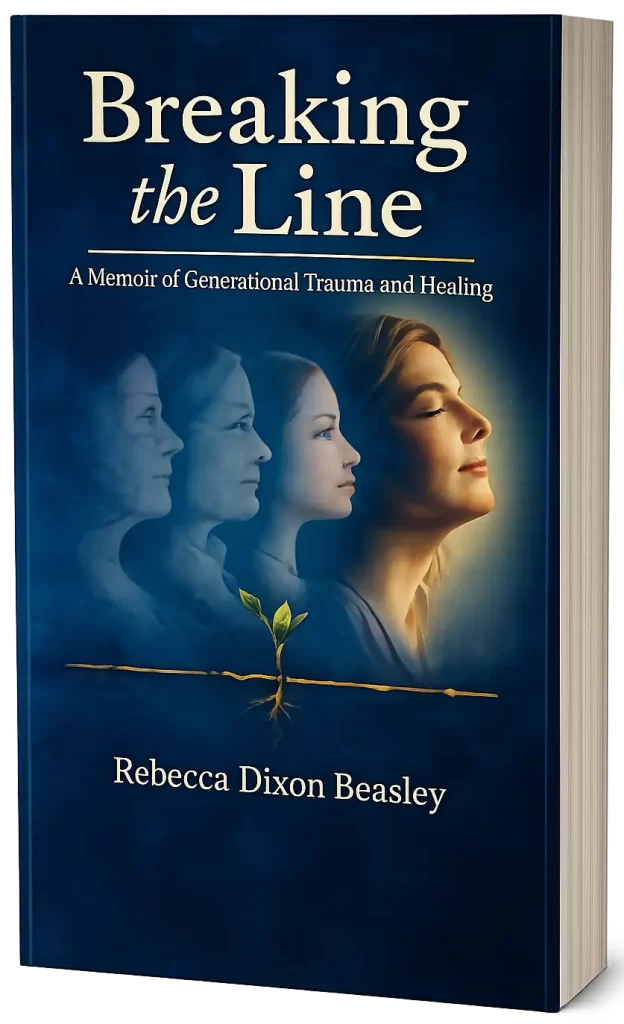
Breaking the Line
A Memoir of Generational Trauma and Healing
What if the struggles you carry did not begin with you?
Breaking the Line is Rebecca Dixon Beasley’s deeply personal exploration of family trauma, survival, science, and healing across generations.
Beginning with family history and continuing through her own childhood and adulthood, Rebecca examines how generations shaped by war, poverty, loss, religious pressure, violence, secrecy, betrayal, addiction, parentification, and emotional survival created patterns that continued long after the original crises were gone.
Yet Rebecca does something unusual with the memoir form.
She does not only tell the story.
She stops to examine it.
Part Memoir. Part Living Case Study.
Throughout the book, Rebecca brings together personal narrative and analytical reflection.
Readers encounter emotionally vivid scenes alongside accessible explorations of:
- generational trauma
- complex childhood trauma
- family systems
- attachment
- nervous-system responses
- the HPA axis
- stress biology
- emerging epigenetic research
- parentification
- hypervigilance
- perfectionism
- trauma-driven over-functioning
This creates a reading experience that offers both emotional connection and greater understanding.
What Readers Will Gain
The book can help readers:
Recognize inherited
patterns
Explore how family history may influence present-day beliefs, relationships, and behaviors.
Understand high-
functioning trauma
responses
See how achievement, perfectionism, overwork, caretaking, and control can sometimes develop from survival.
Explore
parentification
Understand what happens when children become responsible for adult problems, siblings, or family stability.
Connect story
with science
Learn how trauma research, nervous-system responses, attachment, and emerging epigenetic research can help explain inherited patterns.
Practice
reflection
Use reader takeaways and guided exercises to begin examining personal experiences with greater clarity.
Imagine a
different legacy
Move from simply understanding the past toward considering what can change next.
This Book Is for You If...
You have
always been
called strong.
You became
responsible
earlier than
other children.
You struggle
to rest
without guilt.
You automatically
take responsibility
when something
goes wrong.
You find yourself
managing other
people’s emotions.
You recognize
repeating family
patterns.
You have achieved a
great deal but
still feel like part
of you is surviving.
Or you simply want to understand why family history can remain present long after the people and events themselves are gone.
Purchase the Book
Available Formats
- Paperback
- Hardcover, if available
- eBook
- Audiobook, when released